


About the NOAA Hazardous Weather Testbed
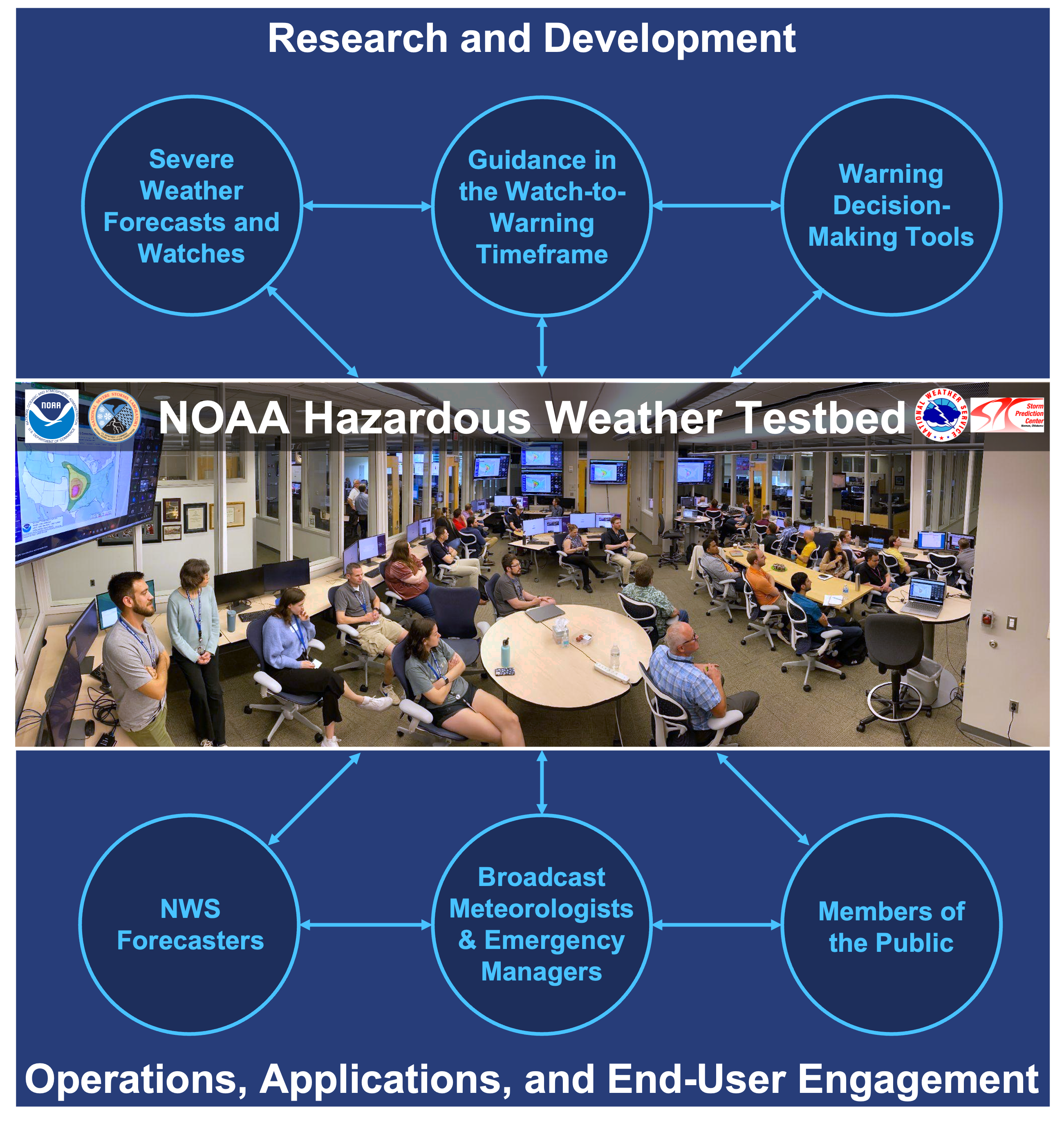
During multiple experiments that take place in the NOAA Hazardous Weather Testbed (HWT) throughout the year, researchers and forecasters work side-by-side to evaluate emerging research concepts and tools in simulated operational settings, including experimental forecast and warning generation exercises. In practice, this effort gives forecasters direct access to the latest research developments while imparting scientists with the knowledge to formulate research strategies that will have practical benefits. This collaborative approach ensures an effective, two-way path between research and operations which ultimately improves National Weather Service forecasts and warnings.
LEADERSHIP
The HWT executive officer (Tony Lyza) serves as the single point of contact for the HWT that coordinates with the HWT board of directors, operational managers, experiment coordinators, and testbed support staff.
The HWT board of directors is composed of the director of NSSL, the director of the NWS Storm Prediction Center (SPC), and the meteorologist-in-charge of the NOAA NWS Norman Forecast Office (OUN). The operational managers consist of the branch directors of the Analysis and Understanding (AUB) and Innovations in Modeling, Predictions, Applications, Communication, and Testbeds (IMPACT) Branches of NSSL, the branch chief of the Science Support Branch at SPC, and the science operations officer of NWS OUN.

Facilities
The HWT provides a unique setting that encourages interaction between researchers and the people who most benefit from research — forecasters. The HWT facilities include a combined forecast and research area placed between the operations areas of the SPC and OUN, and the nearby NSSL Development Lab. The Development Lab includes multiple wall-mounted displays and 10 workstations. Researchers, forecasters, developers, and emergency managers use the lab to evaluate new platforms and techniques in real-time as a team. Collaboration among these diverse groups provides valuable feedback that can immediately be applied to the research and development process, streamlining technology transfer.

Meeting NOAA, OAR, and NWS Mission, Strategic Goals, and Science Priorities
NOAA’s mission is to serve society’s needs for weather and water information. OAR’s science priorities include integrating emerging technologies and transitioning research into operations and applications. NWS’s strategic goals aim to reduce the loss of life and property and damage to the U.S. economy. The HWT supports both of these goals by increasing the development, application, and transition of advanced science and technology to operations and services, and looking for ways to increase the lead-time and accuracy for weather and water warnings and forecasts.